
Modi is courting Japanese investment in an ambitious industrial "corridor" to run between Delhi and Mumbai.

Passenger vehicle market leaders Maruti Suzuki and Hyundai on Saturday reported a decline in wholesales in December 2021, although homegrown majors Tata Motors and Mahindra & Mahindra reported growth, amid semiconductor shortage continuing to impact production. Other manufacturers Nissan and Skoda also reported an increase in December 2021 sales although Honda Cars India witnessed a decline last month. The country's largest carmaker Maruti Suzuki India (MSI) reported a 4 per cent fall in wholesales to 153,149 units in December 2021 as against 160,226 units a year ago.

That means a manufacturer looking at a market like India needs to decide whether small, cheap cars or small, expensive cars or both will work better for them, says Pavan Lall.

Poor contract workers often have little or no access to safety equipment or health benefits in factories.

Auto majors, including Maruti Suzuki India, Hyundai and Tata Motors, on Sunday reported high double-digit growth in their domestic passenger vehicle sales in July riding on stabilisation of macro-economic factors and better consumer sentiments. Similarly, Honda, Nissan, MG Motor and Skoda also reported healthy growth in their sales last month leveraging on improved market mood amid prevailing lower coronavirus infection rate, despite supply constraints of semi-conductors. The country's largest carmaker Maruti Suzuki India's (MSI) domestic sales increased by 39 per cent to 1,41,238 units last month as against 1,01,307 units in July 2020, the company said in a statement.

Industry watchers attribute a lot of the current successes of the $6 billion Hero Group to how B M Munjal planned and executed succession in HeroCorp, balancing the interests of other family-owned businesses.
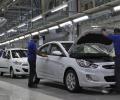
Automotive retail sales saw a 14 per cent rise in March on a year-on-year (YoY) basis, according to data released by the Federation of Automobile Dealers Associations (FADA). For the whole of financial year 2022-23 (FY23), sales grew 21 per cent YoY. For both March and the financial year, all categories, except for tractors, and including two-wheelers, three-wheelers, passenger vehicles (PVs), and commercial vehicles (CVs), posted double-digit growth. However, the total retail sales of 22.1 million for the financial year were still 12 per cent lower than the pre-Covid (FY20) level of 25 million, owing to an 18 per cent dip in the two-wheeler segment.

Major automakers, including Maruti Suzuki, Hyundai, Tata Motors, Mahindra & Mahindra, Kia, Toyota and Honda, on Thursday reported healthy growth in passenger vehicles sales in June, recovering from the disruptions induced by the second wave of COVID-19. The country's largest carmaker Maruti Suzuki India (MSI) posted total sales of 1,47,368 units in June, up from 46,555 units in May. Its domestic dispatches to dealers last month stood at 130,348 units, up from 35,293 units in May, as easing of COVID-related restrictions helped the auto major to dispatch more units to dealerships.

Passenger vehicle exports from India increased 43 per cent in FY22, with Maruti Suzuki India leading the segment with dispatches of over 2.3 lakh units, as per the latest data by industry body SIAM. The total passenger vehicle (PV) exports stood at 5,77,875 units in 2021-22 fiscal, as compared to 4,04,397 units in 2020-21. Passenger car shipments saw 42 per cent growth at 3,74,986 units, while utility vehicle exports rose 46 per cent at 2,01,036 units during the last fiscal, the data by the Society of Indian Automobile Manufacturers (SIAM) showed.

Leading automakers Maruti Suzuki, Hyundai and Tata Motors on Thursday reported robust sales in March as a shift towards personal mobility and pent up demand continued to help companies push dispatches to their respective retail partners. Toyota Kirloskar Motor, Honda Cars and Mahindra and Mahindra (M&M) also reported strong sales last month as compared to the year-ago period, when dispatches were adversely impacted due to the impending transition to BSVI from April 2020 and the nationwide lockdown to contain the coronavirus pandemic. The country's largest carmaker Maruti Suzuki India said its domestic sales stood at 1,49,518 units last month. The auto major had reported sales of 76,976 units in March 2020.

Select metal stocks rebounded while power stocks extended losses after SC verdict on coal block allocations.

As the production of Micra, the first car from Nissan-Renault, starts at the plant by the end of May, Kiminobu Tokuyama, managing director and chief executive of Nissan Motor India Pvt Ltd, talks to rediff.com about the company's strategy for India, the recession and the auto sector in general.

A clutch of automakers including Maruti Suzuki, Hero MotoCorp, Mercedes Benz India, Eicher Motors, TVS Motor, and Isuzu Motors India announced they had got the clearance from the governments of the states they operate in to resume operations.

Cumulative sales of India's top passenger vehicle makers -- Maruti Suzuki, Mahindra and Mahindra, Tata Motors, Honda Cars, and Toyota Kirloskar -- increased to 206,418 units in February over 200,322 units in the same month last year, an increase of 3 per cent.
Will the new unisex scooter successfully take on the best-selling Activa in India? Read on

Buying a car, particularly a diesel-powered one, is set to pinch the customers' pockets even more from the next financial year, as the second phase of Bharat Stage VI (BSVI) emission norms kicks in. The rules require cars to be compliant with real driving emission (RDE) norms, which measure pollutants emitted by cars while they are being driven on the road, unlike in a laboratory test. The norms may increase the cost of producing diesel vehicles by nearly Rs 75,000 to Rs 80,000, and petrol-powered ones by Rs 25,000 to Rs 30,000, analysts said.

With cars like the Toyota Corolla and the Honda Civic selling in very small numbers and potentially even being phased out, the Octavia has very little competition, says Pavan Lall.
The new financial year started on a mixed note for car makers.

The company had launched the Yaris in May 2018 at a price range of Rs 8.75 lakh and Rs 14.07 lakh (ex-showroom), competing with the likes of Honda City, Hyundai Verna and Maruti Suzuki Ciaz. However, it didn't have a robust response in the market, clocking a cumulative wholesales of around 19,800 units.

Maruti Suzuki, Hyundai, Honda Cars and Tata Motors posted single digit growth during the period under review while M&M reported decline in sales.

With a new chief executive officer (CEO) at the helm, the country's largest two-wheeler maker Hero MotoCorp is now looking to cut flab and move towards a leaner organisation. It has launched a voluntary retirement scheme (VRS) for its staff as it aims to make the organisation 'agile and future-ready'. Recently, the company's erstwhile chief financial officer (CFO) Niranjan Gupta was elevated as CEO.
However, notable absentees from the expo will be Honda, Toyota, Ford, BMW, Audi, Lexus, Volvo and Jaguar Land Rover along with two-wheeler majors Hero MotoCorp, Bajaj Auto and TVS Motor Co.
'What volumes will we have with a Rs 1 lakh product?' 'As a company, we will not restrict it to a segment.'
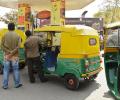
Amid a shift in mobility trends and people increasingly opting for less polluting energy sources, sales of compressed natural gas (CNG) vehicles increased more than 82 per cent in the past five years. A total of 729,902 CNG vehicles were sold in 2022-23 against 400,825 in 2017-18, according to VAHAN Dashboard. Though the increase in sales of CNG-powered vehicles has been significant, their share in overall vehicle sales remains minuscule as is the case with EVs.

Rajesh Karkera and Hitesh Harisinghani spotted these beauties at the Auto Expo 2018

New participants included Chinese players such as Great Wall Motors and Haima Automobile along with Olectra.

While the country's largest car maker, Maruti Suzuki India, said its car will become costly by two per cent, Hyundai Motor India said it will result in a price rise of Rs 6,500-25,000 on average.
Hero MotoCorp continues to update its products, albeit silently, to take on competition from Suzuki Slingshot, Honda Shine and TVS Phoenix

High on features, high on price and performance, these eight superbikes scorched the Indian roads this year!

With its new premium Primus and Ampere NXG, it is targeting buyers seeking a faster and more stylish ride
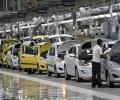
Data available from top six players - Maruti Suzuki, Hyundai, M&M, Tata Motors, Honda and Toyota - shows an average growth of about 42 per cent for the industry in June

India must integrate more with East Asia by getting into regional trade arrangements, lower its tariff walls, and improve the quality of its workforce, suggests T N Ninan.

Maruti Suzuki, Hyundai, Mahindra and Toyota reported low single-digit sales growth for the month owing to weak market sentiment

Maruti's exports in May were down 2.4% at 9,089 units
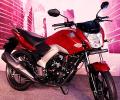
How does Honda CB Unicorn 160 fare against its rivals? MotorOctane.com weighs in.

India has a history of jugaad, and retrofitting vehicles is one such manifestation of the legendary Indian skill. Not so long ago autorickshaws and small Marutis used to strap on subsidised LPG cylinders and power themselves to a cheap ride. There were the odd explosions, lives were lost, but the jugaad continued. Then compressed natural gas (CNG) was introduced in Delhi following a court order. Initially, customised CNG kits were fitted to conventional (internal combustion engine or ICE) autos cheaply, enabling commuting at less than half of what you would cough up for diesel. The industry is better organised now with Suzuki and Hyundai designing CNG-fired vehicles, and Mahindra and TVS manufacturing liquefied petroleum gas (LPG)-powered three wheelers.
Major automobile manufacturers like Maruti Suzuki, Hyundai, Mahindra & Mahindra, Tata Motors and Toyota Kirloskar on Tuesday reported decline in domestic passenger vehicle sales in May compared to the previous month as a spike in COVID-19 cases and lockdowns across various states hit production and dispatches. The country's largest carmaker Maruti Suzuki India (MSI), which shut production from May 1 to May 16 so as to divert oxygen from industrial use for medical purposes, reported domestic dispatches to dealers at 35,293 units last month, down 75 per cent from 142,454 units in April. The company said sales of its mini cars, comprising Alto and S-Presso, declined by 81 per cent to 4,760 units in May as against 25,041 units in April this year.

Electric two-wheelers have zipped past the half-a-million registration mark and achieved a market penetration of 4 per cent at the fag end of Calendar 2022, according to data released by VAHAN. According to VAHAN data for the year (until December 27), 560,000 two-wheelers were registered in the country, up a staggering fourfold over 2021, when only 136,000 were registered, and when electric vehicle penetration was a mere 1.05 per cent. The total number of two-wheelers (internal combustion engine, or ICE, and electric) registered so far in 2022 stands at 14.5 million, up only 12.7 per cent over the previous calendar year.

Take out Maruti Suzuki and Honda, and the auto sector's prospects suddenly don't look all that rosy.
Here are three superbikes that will be jostling for your attention in the times ahead.
